
Показать сокращенную информацию
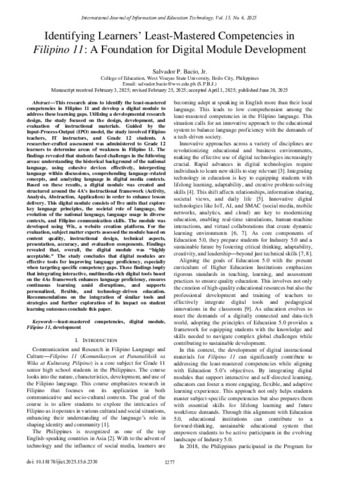
Identifying learners’ least-mastered competencies in Filipino 11: A foundation for digital module development
| dc.contributor.author | Bacio, Salvador P., Jr. | |
| dc.date.accessioned | 2026-02-12T01:51:35Z | |
| dc.date.available | 2026-02-12T01:51:35Z | |
| dc.date.issued | 2025-06-20 | |
| dc.identifier.citation | Bacio, S. P., Jr. (2025). Identifying learners’ least-mastered competencies in Filipino 11: A foundation for digital module development. International Journal of Information and Education Technology, 15(6), 1277-1288. https://doi.org/10.18178/ijiet.2025.15.6.2330 | en |
| dc.identifier.issn | 2010-3689 | |
| dc.identifier.uri | https://hdl.handle.net/20.500.14353/982 | |
| dc.description.abstract | This research aims to identify the least-mastered competencies in Filipino 11 and develop a digital module to address these learning gaps. Utilizing a developmental research design, the study focused on the design, development, and evaluation of instructional materials. Guided by the Input-Process-Output (IPO) model, the study involved Filipino teachers, IT instructors, and Grade 12 students. A researcher-crafted assessment was administered to Grade 12 learners to determine areas of weakness in Filipino 11. The findings revealed that students faced challenges in the following areas: understanding the historical background of the national language, using cohesive devices effectively, interpreting language within discussions, comprehending language-related concepts, and analyzing language in digital media contexts. Based on these results, a digital module was created and structured around the 4A’s instructional framework (Activity, Analysis, Abstraction, Application) in order to enhance lesson delivery. This digital module consists of five units that explore key language principles, the societal role of language, the evolution of the national language, language usage in diverse contexts, and Filipino communication skills. The module was developed using Wix, a website creation platform. For the evaluation, subject matter experts assessed the module based on content quality, instructional design, technical aspects, presentation, accuracy, and evaluation components. Findings revealed that, overall, the digital module was “highly acceptable.” The study concludes that digital modules are effective tools for improving language proficiency, especially when targeting specific competency gaps. These findings imply that integrating interactive, multimedia-rich digital tools based on the 4As framework enhances language proficiency, ensures continuous learning amid disruptions, and supports personalized, flexible, and technology-driven education. Recommendations on the integration of similar tools and strategies and further exploration of its impact on student learning outcomes conclude this paper. | en |
| dc.description.sponsorship | This research was funded by the University Research Development Center of West Visayas State University supports this endeavor. | en |
| dc.language.iso | en | en |
| dc.publisher | IACSIT Press | en |
| dc.relation.uri | https://www.ijiet.org/vol15/IJIET-V15N6-2330.pdf | en |
| dc.rights | Attribution 3.0 United States | * |
| dc.rights.uri | http://creativecommons.org/licenses/by/3.0/us/ | * |
| dc.subject | Development | en |
| dc.subject | Filipino 11 | en |
| dc.subject | Least-mastered competencies | en |
| dc.subject | Digital module | en |
| dc.subject | Digital instructional materials | en |
| dc.subject | Language proficiency | en |
| dc.subject | Filipino language instruction | en |
| dc.subject | Self-directed learning | en |
| dc.subject | E-module | en |
| dc.subject | Developmental research | en |
| dc.subject | Filipino language learning | en |
| dc.subject | E-learning platform | en |
| dc.subject | Multimedia-enhanced educational content | en |
| dc.subject.lcsh | Instructional and educational works | en |
| dc.subject.lcsh | Teaching--Aids and devices | en |
| dc.subject.lcsh | Filipino language--Study and teaching | en |
| dc.subject.lcsh | Self-managed learning | en |
| dc.title | Identifying learners’ least-mastered competencies in Filipino 11: A foundation for digital module development | en |
| dc.type | Article | en |
| dcterms.accessRights | Open access | en |
| dc.citation.journaltitle | International Journal of Information and Education Technology | en |
| dc.citation.volume | 15 | en |
| dc.citation.issue | 6 | en |
| dc.citation.firstpage | 1277 | en |
| dc.citation.lastpage | 1288 | en |
| local.isIndexedBy | ISI | en |
| dc.subject.sdg | SDG 4 - Quality education | en |
Файлы в этом документе
Данный элемент включен в следующие коллекции
-
Journal articles published externally [136]
Journal articles published externally, written by WVSU faculty members, staff, and students

Except where otherwise noted, this item's license is described as Attribution 3.0 United States
Связанные элементы
Просмотр элементов, связанных по названию, автору, создателю или теме.
-
Leadership styles of Thai administrators and performance and satisfaction in the job of Filipino teachers in Thai schools
(West Visayas State University, 2017-05)This study determined the leadership styles of Thai administrators and performance and satisfaction in the job of Filipino teachers in Thai schools. This descriptive method of research was conducted using the purposive ... -
Mga hindi na master na kompetensi sa komunikasyon at pananaliksik sa wika at kulturang Pilipino: Batayan sa pagbuo ng 21st century skills modyul
(West Visayas State University, 2022-10)Ang pag-aaral na ito ay naglayong makabuo ng isang modyul bilang kagamitang pampagtuturo na lilinang ng ika-21 siglong kakayahan ng mga mag-aaral sa asignaturang Komunikasyon at Pananaliksik sa Wika at Kulturang Pilipino ... -
Aeta creatives in the 21st century: Intercultural implications of teaching
(College of PESCAR, West Visayas State University, 2017-12)Panay is an island in the Philippines where groups of the aborigines called Ati are located. In Iloilo and Guimaras, the Ati have found mountains and valleys to settle in after centuries of wandering as nomads. The mainstream ...