
Показать сокращенную информацию
Peer instruction method: Its effects on problem solving performance and attitude towards Physics
| dc.contributor.advisor | Gabasa, Chive G. | |
| dc.contributor.author | Estuche, Anabelle G. | |
| dc.date.accessioned | 2026-05-14T03:38:57Z | |
| dc.date.available | 2026-05-14T03:38:57Z | |
| dc.date.issued | 2015-03 | |
| dc.identifier.citation | Estuche, A. G. (2015). Peer instruction method: Its effects on problem solving performance and attitude towards Physics [Master's thesis, West Visayas State University]. WVSU Institutional Repository and Electronic Dissertation and Theses PLUS. | en |
| dc.identifier.uri | https://hdl.handle.net/20.500.14353/1092 | |
| dc.description.abstract | This quantitative, quasi-experimental research was conducted to determine the problem solving performance of 60 senior students in Physics class. A total of two (2) sections with thirty (30) students each were considered in this study. One section (30 students) was the experimental group exposed to peer instruction method and the other section (30 students) was the control group or exposed to traditional method of teaching physics. The choice whether a certain group was subjected to peer instruction or traditional method was done through a toss-coin method. This pretest posttest method of research utilized a researcher- made problem solving performance test on selected topics in physics and a researcher- made questionnaire on attitude towards physics. The statistical tools used were mean and standard deviation for descriptive statistics and t-test for independent and dependent samples for 0.05 alpha level for inferential statistics. The findings showed that students were beginners in terms of the degree of understanding of the topics presented before intervention had been made and both had a positive attitude towards Physics. After the intervention, both groups maintained their positive attitude towards Physics and the performance the experimental group became proficient and the control group was approaching proficiency. No significant difference existed between the pre treatment performances but a significant difference was noted in the post-treatment performances of the two groups, in favor of the experimental group. There is no significant difference between the attitudes of all the students towards Physics during the pre-intervention but a significant difference was noted in the post-intervention of the two groups in favor of the experimental group. Significant differences were noted between the pre- and post-treatment performances of each group. Moreover, a significant difference existed in the mean gain scores between the experimental and the control groups were revealed, in favor of the experimental group. Further, a significant difference was noted in the attitude of the students towards Physics between the pre- and post-intervention of the experimental group while in the control group showed no significance. | en |
| dc.format.extent | xiii, 133 p. | en |
| dc.language.iso | en | en |
| dc.subject | peer instruction method | en |
| dc.subject | peer mentoring | en |
| dc.subject | problem-solving performance | en |
| dc.subject | quantitative, quasi-experimental research | en |
| dc.subject | problem solving skills | en |
| dc.subject | attitude towards Physics | en |
| dc.subject | Physics education | en |
| dc.subject.lcsh | Peer teaching | en |
| dc.subject.lcsh | Physics--Study and teaching (Continuing education) | en |
| dc.subject.lcsh | Physics problem solving | en |
| dc.subject.lcsh | Educational strategies | en |
| dc.subject.lcsh | Students--Attitudes | en |
| dc.title | Peer instruction method: Its effects on problem solving performance and attitude towards Physics | en |
| dc.type | Thesis | en |
| dcterms.accessRights | Limited public access | en |
| thesis.degree.discipline | Physics | en |
| thesis.degree.grantor | West Visayas State University | en |
| thesis.degree.level | Masters | en |
| thesis.degree.name | Master of Arts in Education | en |
| dc.contributor.chair | Arellano, Elvira L. | |
| dc.contributor.committeemember | Buban, Larry D. | |
| dc.contributor.committeemember | Morano, Lourdes N. | |
| dc.subject.sdg | SDG 4 - Quality education | en |
Файлы в этом документе
| Файл | Размер | Формат | Просмотр |
|---|---|---|---|
|
В этом документе нет ни одного файла. |
|||
Данный элемент включен в следующие коллекции
-
2. Master's Theses [224]
Связанные элементы
Просмотр элементов, связанных по названию, автору, создателю или теме.
-
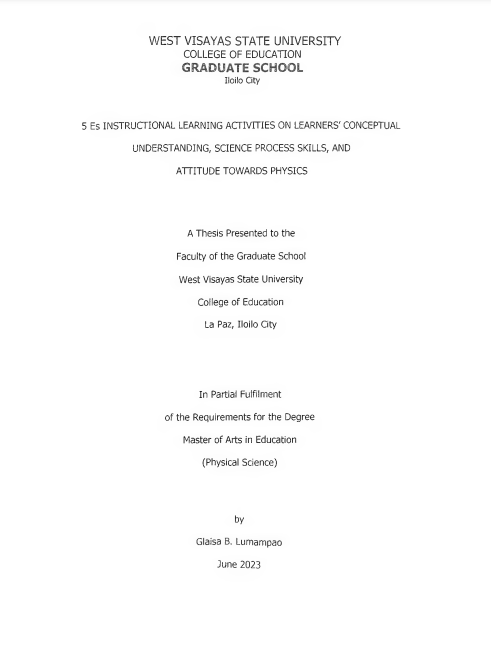
5 Es instructional learning activities on learner's conceptual understanding, science process skills, and attitudes towards Physics
(West Visayas State University, 2023-06)This research is rooted in the existing educational issue in science education, focusing on the successful attainment of science process skills and conceptual understanding, and the promotion of positive attitudes towards ... -
The teacher-coach: Understanding byways of Ilonggo physical education teachers' myriad roles
(West Visayas State University, 2020-06)This study aimed to look into the byways of Ilonggo Physical Education teachers' myriad roles. Six teacher-coaches were the participants of this study. They were purposively selected based on the degree they graduated and ... -
Influence of robotics-aided lessons on students' physics achievement
; Gerardo, Bobby (University Research and Development Center, West Visayas State University, 2014-06)
This research paper aimed to determine the effects of robotics-aided lessons on students’ physics achievement using the experimental design. The experimental group was exposed to instruction using the RCX programmable LEGO ...
(University Research and Development Center, West Visayas State University, 2014-06)
This research paper aimed to determine the effects of robotics-aided lessons on students’ physics achievement using the experimental design. The experimental group was exposed to instruction using the RCX programmable LEGO ...