
Показать сокращенную информацию
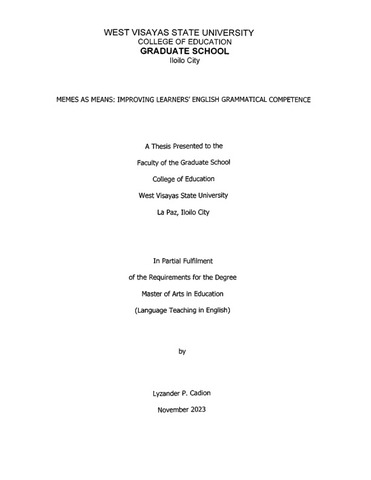
Style, context, and register of Tinglish for teaching contextualized conversational English
| dc.contributor.advisor | Diaz, Venus P. | |
| dc.contributor.author | Prudente, Kenneth John M. | |
| dc.date.accessioned | 2026-01-25T23:54:29Z | |
| dc.date.available | 2026-01-25T23:54:29Z | |
| dc.date.issued | 2024-12 | |
| dc.identifier.citation | Prudente, K. J. M. (2024). Style, context, and register of Tinglish for teaching contextualized conversational English [Master's thesis, West Visayas State University]. WVSU Institutional Repository and Electronic Dissertation and Theses PLUS. | en |
| dc.identifier.uri | https://hdl.handle.net/20.500.14353/957 | |
| dc.description.abstract | The study aimed to determine the style, context, and register of Tinglish for teaching contextualized conversational English in Grade 6 Intensive English Program classrooms in Thailand. Using interlanguage and translanguaging theories within the framework of discourse analysis, ten video and audio recording sessions were transcribed, coded, and analyzed. The prevalent styles students used when employing Tinglish in the classroom reflected the distinct characteristics encompassing vocabulary choices, sentence structures, tone, and rhetorical devices. Key vocabulary patterns included interchange functions, literal translation, clipping, coining, and loanwords, demonstrating adaptation to their linguistic context. In terms of sentence structure, students frequently omitted articles; varied tense and aspect usage; and exhibited unique placements of conjunctions, adjectives, prepositions, and questions with punctuation reflecting spoken rather than written norms. Their communication alternates among five distinct tones while employing rhetorical devices emerged as integral features, enriching classroom interactions. Their registers revealed how social roles and dynamics shape interactions, blending formal and informal styles to express politeness and respect. These linguistic features are set in the context of Thai cultural and contextual references, which heavily influenced students' use of Tinglish. As students adopt these styles and registers, the study demonstrated that recognizing and integrating the unique characteristics of Tinglish can promote contextualized English instruction, aligning with students' linguistic abilities and leading to more effective and culturally responsive teaching in conversational English. | en |
| dc.format.extent | xiv, 250 p. | en |
| dc.language.iso | en | en |
| dc.subject | Tinglish | en |
| dc.subject | Translanguaging | en |
| dc.subject | Language variation | en |
| dc.subject | Interlanguage | en |
| dc.subject | Contextualization | en |
| dc.subject | Mixed language | |
| dc.subject | Contextualized conversional English | |
| dc.subject | Intensive English Program (IEP) Classroom | |
| dc.subject | Translanguaging theories | |
| dc.subject | Registers of Tinglish | |
| dc.subject | Thai English | |
| dc.subject | Context | |
| dc.subject | Style | |
| dc.subject.lcsh | English language teaching -- Thailand | en |
| dc.subject.lcsh | Discourse analysis | en |
| dc.subject.lcsh | Translanguaging (Linguistics) | en |
| dc.subject.lcsh | Language acquisition | |
| dc.subject.lcsh | Language and languages--Study and teaching | |
| dc.subject.lcsh | Languages, Mixed | |
| dc.subject.lcsh | Interlanguage (Language learning) | |
| dc.subject.lcsh | Language and languages--Variation | |
| dc.subject.lcsh | Second language acquisition | |
| dc.subject.lcsh | Fluency (Language learning) | |
| dc.title | Style, context, and register of Tinglish for teaching contextualized conversational English | en |
| dc.type | Thesis | en |
| dcterms.accessRights | Limited public access | en |
| thesis.degree.discipline | Language Teaching - English | en |
| thesis.degree.grantor | West Visayas State University | en |
| thesis.degree.level | Masters | en |
| thesis.degree.name | Master of Arts in Education | en |
| dc.contributor.chair | Tubal, Michael Caesar C. | |
| dc.contributor.committeemember | Felimon, Rosemarie G. | |
| dc.contributor.committeemember | Guzman, Bobbie M. |
Файлы в этом документе
Данный элемент включен в следующие коллекции
-
2. Master's Theses [224]
Связанные элементы
Просмотр элементов, связанных по названию, автору, создателю или теме.
-
Relationship of teachers' qualifications and teaching methodology to pupils' English language performance
(2016-04)This study determined the differences and relationships of teachers' qualifications and teaching methodology to pupils' English language performance, using as subjects 17 entirely chosen grade six English teachers in the ... -
A contrastive rhetoric analysis of English essays among bilingual learners
(Graduate School, College of Education, West Visayas State University, 2011-08)The current study identified and categorized most commonly committed errors among bilingual learners using their English essays. It attempted to give the reasons why they committed such errors, and explained how the learners' ... -
Memes as means: Improving learners' English grammatical competence
(2023-11)In the present generation, one of the challenges that language teachers face is to find innovative ways to hook students' interests to improve grammar competence in the teaching and learning process of the English language. ...