

Perspectives on superiority humor towards grammatical errors

Share
Abstract
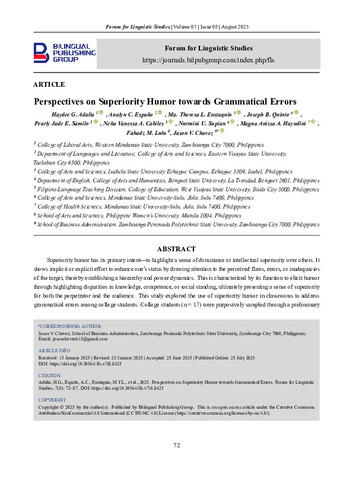
Superiority humor has its primary intent—to highlight a sense of dominance or intellectual superiority over others. It shows implicit or explicit effort to enhance one's status by drawing attention to the perceived flaws, errors, or inadequacies of the target, thereby establishing a hierarchy and power dynamics. This is characterized by its function to elicit humor through highlighting disparities in knowledge, competence, or social standing, ultimately presenting a sense of superiority for both the perpetrator and the audience. This study explored the use of superiority humor in classrooms to address grammatical errors among college students. College students (n = 17) were purposively sampled through a preliminary online open-ended questionnaire. Narratives were collected from a one-on-one interview process. The findings revealed that superiority humor, when perceived as mocking or judgmental, acted as a barrier to learning, leading to fear, defensiveness, and reluctance to engage in discussions. Students also viewed sarcastic corrections as attempts to establish superiority, which undermined their confidence and discouraged them from taking risks in language use. Furthermore, humor that seemed excessive or irrelevant to the lesson was perceived as unprofessional, thereby diminishing the credibility of both instructors and the learning environment. In terms of emotional impact, students reported feelings of embarrassment, self-doubt,and heightened perfectionism, particularly when the superiority humor emphasized their mistakes. Such reactions often resulted in decreased participation and an overemphasis on error avoidance, which hindered language development and self-expression. While humor can be a valuable pedagogical tool, its misuse risks alienating learners and reinforcing power imbalances, which undermines effective language.
Contributes to SDGs

Recommended Citation
Adalia, H. G., Españo, A. C., Eustaquio, M. T. L., Quinto, J. B., Samilo, P. J. E., Cabiles, N. V. A., ... & Chavez, J. V. (2025). Perspectives on superiority humor towards grammatical errors.Type
ArticleISSN
2705-0610Keywords
Subject

Collections
- Journal articles published externally [167]
- SDG 03 - Good Health and Well-Being - WVSU's Contributions to UN Sustainable Development Goals [85]
- SDG 04 - Quality Education - WVSU's Contributions to UN Sustainable Development Goals [187]
- SDG 10 - Reduced Inequalities - WVSU's Contributions to UN Sustainable Development Goa [29]

Except where otherwise noted, this item's license is described as Attribution-NonCommercial 4.0 International