
Realities of upland communities: Tales of culture and survival


Share
Abstract
Purpose The purpose of this ethnographic study was to explore and gain a deeper understanding of the culture of upland communities belonging to Indigenous Peoples (IPs) and Indigenous Cultural Communities (ICCs) residing in the upland regions of the Philippines. Design/methodology/approach Fourteen IPs/ICCs aged 50 years and above participated in the study. Data collection methods included observation, focus group discussions and document analysis. The data were analyzed thematically. Findings The findings reveal that the IPs/ICCs speak a unique homegrown language called Ligbok and maintain strong spiritual beliefs centered on the supernatural. The spirit of Bayanihan is deeply ingrained in their social practices, emphasizing communal cooperation and mutual aid. They follow traditional laws and demonstrate respect for authority figures. Their technologies are predominantly agricultural, with farming being central to their livelihood. However, their heavy reliance on nature makes them highly vulnerable to the adverse effects of climate change. Additionally, their access to education remains limited. Practical implications This study highlights the critical need for the government to strengthen efforts in safeguarding the rights and welfare of ICCs/IPs, in alignment with the Indigenous Peoples' Rights Act and the United Nations Declaration on the Rights of Indigenous Peoples. Originality/value Despite technological advancements, many groups remain unheard, misunderstood and neglected. Among these are the upland communities on Panay Island, whose stories have largely remained untold due to a lack of systematic research and consolidated knowledge about them. Furthermore, the absence of platforms for discourse regarding their plight presents a significant challenge for researchers, hindering efforts to comprehensively understand their lives. These conditions perpetuate discrimination and social inequality. These circumstances paved the way for this study. © 2025 Emerald Publishing Limited
Contributes to SDGs

Recommended Citation
Jabor, R. M., & Pendon, G. P. (2025). Realities of upland communities: Tales of culture and survival.Type
ArticleISSN
1443-9883; 1448-0980Keywords
Subject

Collections
- Journal articles published externally [167]
- SDG 03 - Good Health and Well-Being - WVSU's Contributions to UN Sustainable Development Goals [85]
- SDG 10 - Reduced Inequalities - WVSU's Contributions to UN Sustainable Development Goa [29]
- SDG 15 - Life on Land - WVSU's Contributions to UN Sustainable Development Goals [9]
The following license files are associated with this item:

Except where otherwise noted, this item's license is described as CC0 1.0 Universal
Related items
Showing items related by title, author, creator and subject.
-
Aeta creatives in the 21st century: Intercultural implications of teaching
(College of PESCAR, West Visayas State University, 2017-12)Panay is an island in the Philippines where groups of the aborigines called Ati are located. In Iloilo and Guimaras, the Ati have found mountains and valleys to settle in after centuries of wandering as nomads. The mainstream ... -
Cultural memory banking in preservice science teacher education
Handa, Vicente C. ; (2012-12)
This study focused on the exemplification of cultural memory banking as an ethnographic tool to understand cultural practices relevant to science teaching and learning in a rural coastal village in a central island of the ...
; (2012-12)
This study focused on the exemplification of cultural memory banking as an ethnographic tool to understand cultural practices relevant to science teaching and learning in a rural coastal village in a central island of the ... -
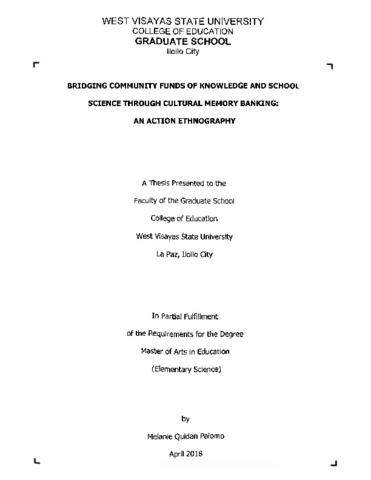
Bridging community funds of knowledge and school Science through cultural memory banking: An action ethnography
(West Visayas State University, 2018-04)This study aimed at answering the call for culturally relevant pedagogy and community-centered K to 12 Science Basic Education Curriculum to preserve the local cultural heritage through cultural memory banking of the ...