
Preservation habits towards sustainable use of the Filipino language
Share
Abstract
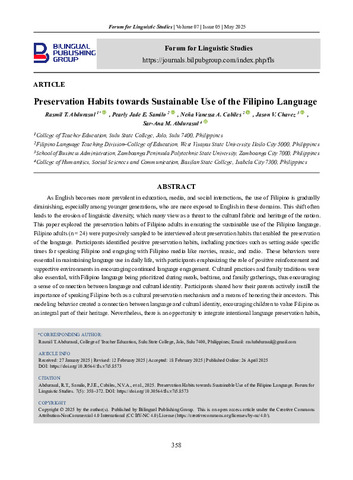
As English becomes more prevalent in education, media, and social interactions, the use of Filipino is gradually diminishing, especially among younger generations, who are more exposed to English in these domains. This shift often leads to the erosion of linguistic diversity, which many view as a threat to the cultural fabric and heritage of the nation. This paper explored the preservation habits of Filipino adults in ensuring the sustainable use of the Filipino language. Filipino adults (n=24) were purposively sampled to be interviewed about preservation habits that enabled the preservation of the language. Participants identified positive preservation habits, including practices such as setting aside specific times for speaking Filipino and engaging with Filipino media like movies, music, and radio. These behaviors were essential in maintaining language use in daily life, with participants emphasizing the role of positive reinforcement and supportive environments in encouraging continued language engagement. Cultural practices and family traditions were also essential, with Filipino language being prioritized during meals, bedtime, and family gatherings, thus encouraging a sense of connection between language and cultural identity. Participants shared how their parents actively instill the importance of speaking Filipino both as a cultural preservation mechanism and a means of honoring their ancestors. This modeling behavior created a connection between language and cultural identity, encouraging children to value Filipino as an integral part of their heritage. Nevertheless, there is an opportunity to integrate intentional language preservation habits, family traditions, and supportive environments in sustaining the use of the Filipino language across generations.
Contributes to SDGs
Recommended Citation
Abdurasul, R. T., Samilo, P. J. E., Cabiles, N. V. A., Chavez, J. V., & Abdurasul, S.-A. (2025). Preservation habits towards sustainable use of the Filipino language.Type
ArticleISSN
2705-0610Keywords
Subject

The following license files are associated with this item:

Except where otherwise noted, this item's license is described as Attribution 3.0 United States
Related items
Showing items related by title, author, creator and subject.
-
Style, context, and register of Tinglish for teaching contextualized conversational English
(2024-12)The study aimed to determine the style, context, and register of Tinglish for teaching contextualized conversational English in Grade 6 Intensive English Program classrooms in Thailand. Using interlanguage and translanguaging ... -
Mother tongue: for teaching and learning
; ; Dequilla, Ma. Asuncion Christine ; ; Rosano, Daisy ; (LORIMAR Publishing, Inc., 2016)
In the midst of curricular changes in education, we felt the need to proactively share ideas and assist future teachers to unravel so many questions on how to teach our own mother tongue. Our dedication to take part in ...
; ; Rosano, Daisy ; (LORIMAR Publishing, Inc., 2016)
In the midst of curricular changes in education, we felt the need to proactively share ideas and assist future teachers to unravel so many questions on how to teach our own mother tongue. Our dedication to take part in ... -
The first one thousand commonly used Hiligaynon words: A Hiligaynon - English compendium for the teaching of mother tongue
; Dequilla, Ma. Asuncion Christine V.; Rosano, Daisy ; (College of Education, West Visayas State University, 2016)
The implementation of Mother Tongue-Based Multilingual Education under the Enhancement Basic Education Act of 2013 has cause a stir not only to the education sector but to the general public as well. Among teachers and ...