
Patient's gender preference for nursing care


Share
Zusammenfassung
Background: Patients gender preference for nursing care is one of the concerns in the hospital setting that have existed in the past few years. However, it remains unclear since it is unexplored and usually not given that much attention. Most studies have identified preferences for medical practitioners and few studies were done concerning gender preferences for nursing care.
Purpose of the study: This study determined the gender preferences for nursing care among the patients of West Visayas State University-Medical Center. This study was conducted August to September 2014.
Methodology: A quantitative-qualitative approach was used with a total of 140 participants selected through quota sampling: 20 participants each from 7 areas of confinement in the hospital. A three-page researcher made survey questionnaire was administered. Eighteen (18) participants were purposively selected for Focus Group Discussion (FGD) to obtain in-depth dimensions of their differences and Thematic Analysis to identify common themes. Ethical approval was granted by WVSU Unified Biomedical Research Ethics Review Committee.
Findings: The study revealed no significant differences in patient's gender preferences for nursing care when classified as to: age, gender, religion, marital status, educational attainments, monthly income, and area of confinement. The following themes were identified according to their preference: Male: "Sturdiness beyond Compassion"—"less emotional", "strong, firm", "works faster"; Female: "the warmth of a Healing Heart"—"compassionate", "approachable and easy to communicate with", "refined and well-detailed"; No preferences: "Professionalism: Basis for Patient's Trust"—"provides the same care", "same training and education", and "I have no choice but if given the chance, I will", "no choice, whomsoever is available".
Recommendations: Further studies are encouraged to broaden and develop this study's identified categories (themes) and with additional respondents for identification of new themes. Studies in different health care settings could be done such as in private health care facilities.
Contributes to SDGs


Recommended Citation
Biscaro, M. G. B., Delgado, J. L., Jacar, J. E., Mamon, J. R. M., Pomoy, S. E., Vallota, M. J. J., & Penuela, A. (2016). Patient's gender preference for nursing care.Type
ArticleISSN
0119-7061
Verwandte Dokumente
Anzeige der Dokumente mit ähnlichem Titel, Autor, Urheber und Thema.
-
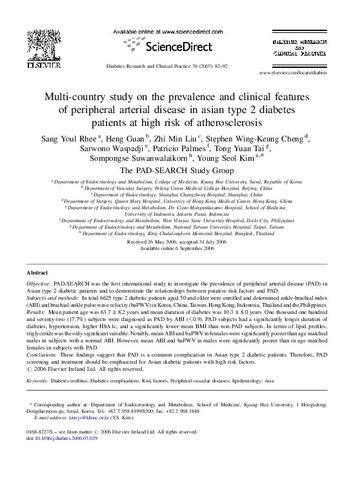
Multi-country study on the prevalence and clinical features of peripheral arterial disease in Asian type 2 diabetes patients at high risk of atherosclerosis
Rhee, Sang Youl ; ; Liu, Zhi-Min ; Cheng, Stephen Wing Keung ; ; Palmes, Patricio ; ; Suwanwalaikorn, Sompongse ; (Elsevier, 2007-04-01)
Objective: PAD-SEARCH was the first international study to investigate the prevalence of peripheral arterial disease (PAD) in Asian type 2 diabetic patients and to demonstrate the relationships between putative risk ...
; ; Liu, Zhi-Min ; Cheng, Stephen Wing Keung ; ; Palmes, Patricio ; ; Suwanwalaikorn, Sompongse ; (Elsevier, 2007-04-01)
Objective: PAD-SEARCH was the first international study to investigate the prevalence of peripheral arterial disease (PAD) in Asian type 2 diabetic patients and to demonstrate the relationships between putative risk ... -
Durability of the beneficial effect of MLC601 (NeuroAiD™) on functional recovery among stroke patients from the Philippines in the CHIMES and CHIMES-E studies
(SAGE Publications Inc., 2017-04)Background and Aim: A pre-specified country analysis of subjects from the Philippines in the CHInese Medicine NeuroAiD Efficacy on Stroke recovery (CHIMES) Study showed significantly improved functional and neurological ... -
Diagnostic utility of urine gram stain versus urinalysis in asymptomatic bacteriuria among pregnant patients
(West Visayas State University Publishing House and Bookstore, 2019-01)BACKGROUND: Urine culture remains to be gold standard in the diagnosis of asymptomatic bacteriuria (ASB) during pregnancy but its use is limited because it is not cost beneficial. In low resource settings, urine gram stain ...