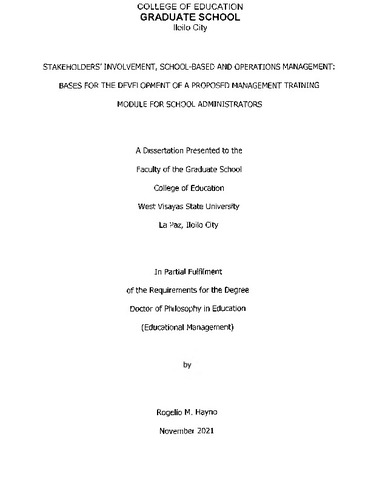

Home and school learning climates as correlates of scholastic achievement: Inputs to the development of a home-school collaboration program
| dc.contributor.advisor | Abioda, Luis A. | |
| dc.contributor.author | Gamba, Reginald F. | |
| dc.date.accessioned | 2026-02-19T04:04:52Z | |
| dc.date.available | 2026-02-19T04:04:52Z | |
| dc.date.issued | 2020-06 | |
| dc.identifier.citation | Gamba, R. F. (2020). Home and school learning climates as correlates of scholastic achievement: Inputs to the development of a home-school collaboration program. [Doctoral dissertation, West Visayas State University]. WVSU Institutional Repository and Electronic Dissertation and Theses PLUS. | en |
| dc.identifier.uri | https://hdl.handle.net/20.500.14353/992 | |
| dc.description.abstract | This survey-correlational study aimed to ascertain the school and home learning climate, and learners' scholastic achievement as inputs to the development of a Home-School Collaboration Program. It likewise aimed to ascertain whether these variables were related significantly. The participants of this study were the 187 randomly selected junior high school learners from a private institution of learning who were enrolled for school year 2019-2020. There were also 145 parent-respondents who were classified according to parent category, age range, number of children, highest educational attainment, and living arrangement. The researcher-made questionnaire was drafted based on readings and related studies on home and school learning climate. Frequency counts, percentage analyses, means and standard deviation were employed for descriptive statistics, while t-test for independent samples, the One-Way ANOVA and the Pearson's r, all set at .05 alpha level of significance were used for inferential statistics. Study results revealed that the school learning climate and the home learning climate in a private institution of learning as assessed by junior high school learners and the parents of these learners were highly favorable. The learners were proficient in all areas of their scholastic achievement. No significant differences existed in the school learning climate that prevailed in a private institution of learning as assessed among junior high school learners classified according to sex and grade level. Likewise, no significant differences existed in school learning climate as assessed among the parents classified according to selected categories of variables. Significant differences were noted in home learning climate as assessed among junior high school learners when grouped according to sex. However, no significant differences existed when the respondents were grouped according to grade level. No significant differences existed in the home learning climate as assessed among parent-respondents when grouped according to selected categories of variables except for age range. There were significant differences in the level of scholastic achievement among the junior high school learners when classified according to sex but revealed no significant differences when classified according to grade level. Significant relationships existed among the learner's assessment of the home learning climate and school learning climate. Significant relationship existed between parents' assessment of school learning climate and home learning. A Home-School Collaboration Program was developed to evaluate and assist the school in making valuable efforts in making such partnership better through various modules that will bridge the gap for the benefit of the learners. It consisted of three areas namely Home School Collaboration Areas (Principles, Attitudes and Procedures), Home School Collaboration Modules for Parents and Student Toolkit. The Home School Collaboration modules for parents consisted of 7 areas patterned with Epstein parental involvement theory and Student Toolkit consisted of 7 areas based on the focus group discussion with chosen learners. Both modules for parents and students consisted of concepts, activities and strategies are easy to understand and comprehensive enough to cover areas of concern. It is flexible enough either given as a formation sessions or a two day full packed sessions. | en |
| dc.format.extent | xii, 234 p. | en |
| dc.language.iso | en | en |
| dc.subject | Home learning climate | en |
| dc.subject | School learning climate | en |
| dc.subject | Scholastic achievement | en |
| dc.subject | Survey-correlational research | en |
| dc.subject | Home-school collaboration program | en |
| dc.subject | Home environment | en |
| dc.subject | Educational collaboration | en |
| dc.subject | Academic performance | en |
| dc.subject | Home learning environment | en |
| dc.subject | Educational development | en |
| dc.subject | Family-school partnerships | en |
| dc.subject.lcsh | Educational evaluation--Management | en |
| dc.subject.lcsh | Academic achievement | en |
| dc.subject.lcsh | Home and school | en |
| dc.subject.lcsh | Education--Parent participation | en |
| dc.subject.lcsh | School-based management | en |
| dc.title | Home and school learning climates as correlates of scholastic achievement: Inputs to the development of a home-school collaboration program | en |
| dc.type | Dissertation | en |
| dcterms.accessRights | Limited public access | en |
| thesis.degree.discipline | Educational Management | en |
| thesis.degree.grantor | West Visayas State University | en |
| thesis.degree.level | Doctoral | en |
| thesis.degree.name | Doctor of Philosophy in Education | en |
| dc.contributor.chair | Jusayan, Shirley R, | |
| dc.contributor.committeemember | Rabanes, Teofilo R. | |
| dc.contributor.committeemember | Loyola, Ma. Lulu L. | |
| dc.contributor.committeemember | Siason, Nordy Jr., D. | |
| dc.subject.sdg | SDG 4 - Quality education | en |
Files in this item
This item appears in the following Collection(s)
Related items
Showing items related by title, author, creator and subject.
-
Stakeholders' involvement, school-based and operations management: Bases for the development of a proposed management training module for school administrators
(West Visayas State University, 2021-11)This study attempted to find out whether the worldwide phenomenon of the increased stakeholders' involvement in school administration and in academic discourse was observable among secondary schools. Respondents of the ... -
Utilization, problems and issues in the implementation of maintenance and other operating expenses
(West Visayas State University, 2018-04)This descriptive survey research aimed to assess the extent of utilization and seriousness of problems and issues of Maintenance and Other Operating Expenses implementation by the public elementary school heads in the ... -
Climbing mountains and crossing seas: Self-actualization of High School Science teachers in hard-to-reach schools
(West Visayas State University, 2018-04)Journey to Self-Actualization. This study examined the experiences of four high school science teachers assigned in hard-to-reach places which led or are leading them to their self-actualization. It focused on their ...