
College students’ knowledge, attitude, and practices on COVID-19 prevention post e-health education program
Share
Zusammenfassung
This study explored if significant improvements in knowledge, attitude, and practices among college students will be observed post E-health education program on COVID-19 prevention. The study reports a pre-post quantitative research on 178 college students. The participants received nine sessions of e-health education developed using the Communicable Disease Control Health Education Curriculum Analysis Tool (HECAT) through Zoom. The adapted and modified questionnaire was developed from previously published literature regarding viral epidemics related to MERS-CoV disease, infection prevention, and control measures for COVID-19 by World Health Organization and the Communicable Disease Control and Prevention guidelines. The first phase gathers the relevant profile and background of the participants, and the last phase comprises post-evaluation. The data were analyzed using SPSS version 27. The results indicate above-average means for knowledge on COVID-19 prevention in the pretest (17.75±2.27) and the posttest (17.60±2.95). Moreover, the participants were aware of the importance of vaccination, social distancing measures, following health protocols, and the essentiality of compliance with government agencies' guidelines. However, the participants were not practicing some of these health measures, as evidenced by the low means in the pretest (1.75±0.97) and posttest (1.66±1.08). All tests for significant differences of pretest and posttest means of knowledge (p=0.46), attitude (p=0.12), and practices (p=0.41) on COVID-19 prevention were all insignificant. Our study provides evidence that the online health education program improved college students' knowledge and attitude toward COVID-19 prevention. Still, they did not adhere to or practice some of the health measures to prevent its transmission.
Contributes to SDGs
Recommended Citation
Villarino, R. T., Villarino, M. L., Temblor, M. C., Bernard, P., & Plaisent, M. (2023). College students’ knowledge, attitude, and practices on COVID-19 prevention post e-health education program.Type
ArticleISSN
22528806Keywords
Schlagwort

Die folgenden Lizenzbestimmungen sind mit dieser Ressource verbunden:

Solange nicht anders angezeigt, wird die Lizenz wie folgt beschrieben: Attribution-NonCommercial-ShareAlike 3.0 United States
Verwandte Dokumente
Anzeige der Dokumente mit ähnlichem Titel, Autor, Urheber und Thema.
-
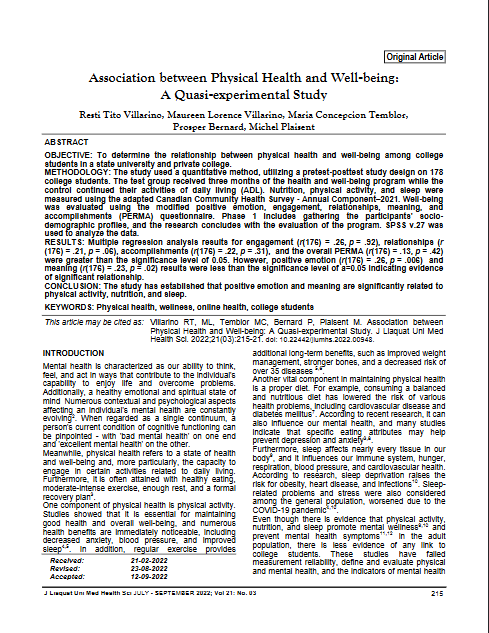
Association between physical health and well-being: A quasi-experimental study
Villarino, Resti Tito ; Villarino, Maureen Lorence ; Temblor, Maria Concepcion ; Bernard, Prosper ; Plaisent, Michel (Liaquat University of Medical and Health Sciences, 2022-09-12)
OBJECTIVE: To determine the relationship between physical health and well-being among college students in a state university and private college. METHODOLOGY: The study used a quantitative method, utilizing a ...
; Villarino, Maureen Lorence ; Temblor, Maria Concepcion ; Bernard, Prosper ; Plaisent, Michel (Liaquat University of Medical and Health Sciences, 2022-09-12)
OBJECTIVE: To determine the relationship between physical health and well-being among college students in a state university and private college. METHODOLOGY: The study used a quantitative method, utilizing a ... -
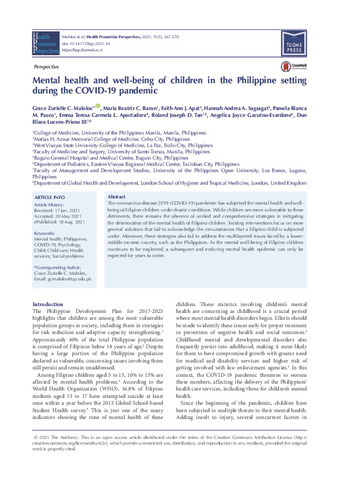
Mental health and well-being of children in the Philippine setting during the COVID-19 pandemic
Malolos, Grace Zurielle C.; Baron, Maria Beatriz C. ; Apat, Faith Ann J. ; ; ; Aportadera, Emma Teresa Carmela L. ; Tan, Roland Joseph D. ; Evardone, Angelica Joyce Gacutno ; Lucero-Prisno, Don Eliseo III (Tabriz University of Medical Sciences, 2021-08-18)
The coronavirus disease 2019 (COVID-19) pandemic has subjected the mental health and wellbeing of Filipino children under drastic conditions. While children are more vulnerable to these detriments, there remains the absence ... -
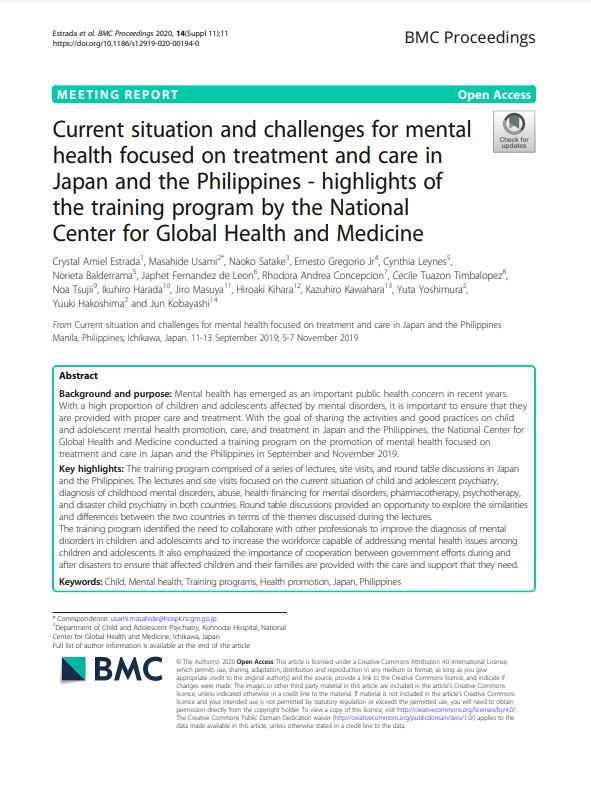
Current situation and challenges for mental health focused on treatment and care in Japan and the Philippines - Highlights of the training program by the National Center for Global Health and Medicine
Estrada, Crystal Amiel; Usami, Masahide ; Satake, Naoko ; Gregorio, Ernesto Jr ; Leynes, Cynthia ; ; ; ; ; Tsujii, Noa ; ; Masuya, Jiro ; ; Kawahara, Kazuhiro ; ; ; Kobayashi, Jun (BioMed Central Ltd, 2020-08-03)
Background and purpose: Mental health has emerged as an important public health concern in recent years. With a high proportion of children and adolescents affected by mental disorders, it is important to ensure that ...