
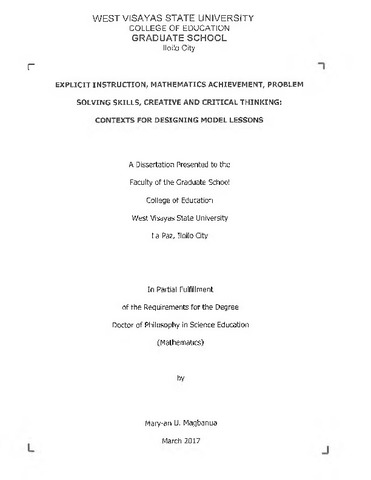
Explicit instruction, Mathematics achievement, problem solving skills, creative and critical thinking: Context for designing model lessons
Date
2017-03Metadata
Show full item recordShare
Abstract
This quasi-experimental matching-only pretest-posttest research sought to determine the effectiveness of explicit instruction on a Problem-Solving course, specifically on students’ mathematics achievement, problem-solving skills, creative and critical thinking skills as contexts for designing model lessons in the mathematics program. This was administered among the two sections of the fourth-year Bachelor in Elementary Education students of the University of Antique, Sibalom, Antique, Philippines, during the first semester, school year 2016-2017. One group of students was taught using explicit instruction and the other group using the traditional instruction. The participants in each group were chosen through a comprehensive match-pairing based on their general weighted average in the mathematics courses from prior semester, sex, and age. After the nine-week intervention, these two groups of students took the post-intervention performance test in mathematics achievement, problem-solving, critical and creative thinking skills. The statistical tool used to determine the effectiveness of the instruction in the 12 lessons presented was the paired ¢test, ¢test for independent sample, and analysis of covariance (ANCOVA). Results showed that explicit instruction has significantly increased students’ performance in the mathematics achievement, problem-solving skills, creative thinking skills, and critical thinking skills with a much larger-than-typical-effect size. Both traditional and explicit instructions have effectively changed the scores of the students from the pretest to the posttest performance in mathematics achievement, problem-solving skills, and creative thinking skills, however, no significant difference was found in the critical thinking skills. Also, explicit instruction shows significantly higher value of mean gain scores than with the traditional instruction in the mathematics achievement, problem-solving skills, and creative thinking skills. However, there was no significant difference between groups in the critical thinking skills. Students in the explicit instruction group changed their perception of looking at mathematics problem-solving. Through explicit instruction, they were amazed, as well as enjoyed and had fun in the interactive and collaborative learning of the instruction which helped them learn and improve their performances. Explicit instruction upgraded students’ performance in the problem-solving course and expand the positive benefit to students. The participants in the aforementioned group have better understanding of the problem or mathematics concept, are able to identify a strategy to the problem and implement them, create new or varied ideas in solving problems, and foster a positive attitude towards explicit instruction. Thus, making it an optimistic approach to venture in teaching mathematics. Hence, utilization of the model lesson with explicit instruction approach is highly recommended in teaching mathematics problem-solving course in improving students’ performance, creative thinking skills, and critical thinking skills.
Contributes to SDGs
Recommended Citation
Magbanua, M. U. (2017). Explicit instruction, mathematics achievement, problem-solving skills, creative and critical thinking: Context for designing model lessons [Doctoral dissertation, West Visayas State University]. WVSU Institutional Repository and Electronic Dissertation and Theses PLUS.
Type
DissertationKeywords
Mathematics achievement Problem-solving skills Creative thinking skills Critical thinking skills Explicit instruction in Mathematics Quasi-experimental Active teaching Explicit teaching Mathematics instruction Math educators Cooperative learning Traditional instruction Problem solving course Designing model lessons Cooperative learning strategies Collaborative learning Mixed method research
Subject

Degree Discipline
MathematicsDegree Name
Doctor of Philosophy in Science EducationDegree Level
DoctoralPhysical Description
xiii, 217 p.
Collections
Related items
Showing items related by title, author, creator and subject.
-
Effects of differentiated instruction on mathematics achievement and critical thinking skills of students
(University Research and Development Center, West Visayas State University, 2017-06)This quasi-experimental study ascertained the effects of differentiated instruction on the mathematics achievement and critical thinking skills of the 54 Grade 10 high school students of a state university in Roxas City. ... -
Exploring the critical thinking skills of absentee students in their non-school activities: A design ethnography
(West Visayas State University, 2017-03)This qualitative research brought to light the critical thinking skills developed by the absentee students in one public secondary school in the Fifth District of the Province of Iloilo. Five participants were purposively ... -
Critical thinking and problem-solving skills assessments in the K-12 mathematics curriculum: Bases for the development of problem-based learning modules
(West Visayas State University, 2017-03)This developmental research ascertained the levels of critical thinking and problem-solving skills of students under the K-12 Curriculum, particularly in Patterns and on of Algebra. This study also determined the content ...